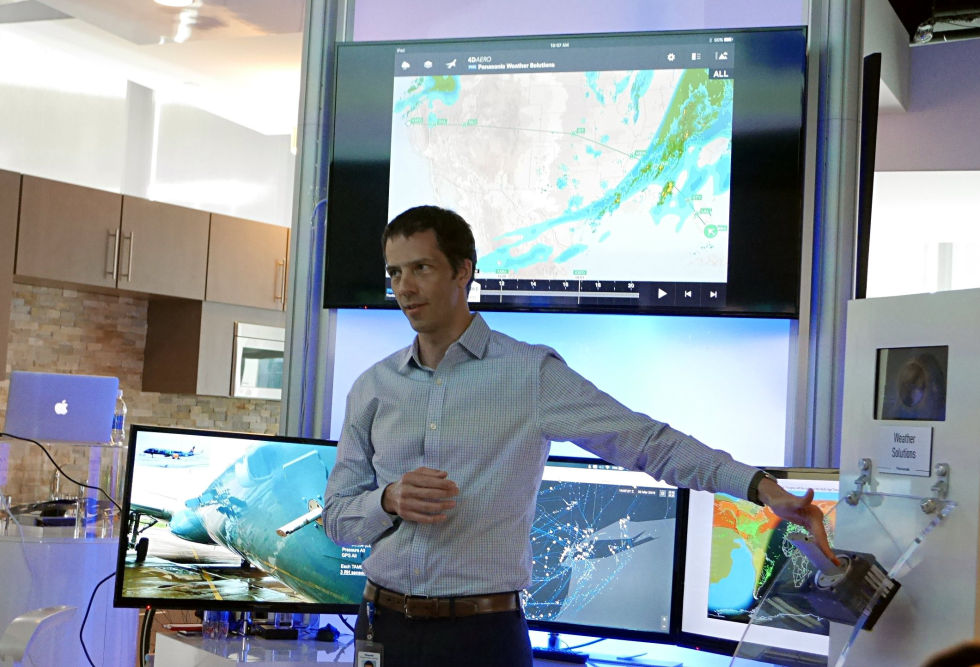
Neil Jacobs, chief atmospheric scientist with Panasonic Weather Solutions, talks about his global weather model (credit: Panasonic Weather Solutions)
For a long time, weather forecasting was largely the domain of governments, with the National Weather Service leading the way in the United States. During the last two decades, however, the private weather forecasting industry—which includes well-known companies such as AccuWeather and many hundreds of smaller businesses—has grown up and is now estimated to be worth as much as $6 billion.
Even so, these companies largely just repackage model forecasts and incorporate data from government weather agencies. The heavy lifting, in the form of sophisticated computer modeling and the processing power to run them, is still done by the large ECMWF center in Europe, NOAA's National Centers for Environmental Prediction in the United States, and similar forecasting services in Canada, Japan, and elsewhere.
All of these government agencies, with staffs generally in the hundreds of scientists, forecasters, and coders, collect weather data from a variety of sources, including shared satellite data along with in-situ observations from aircraft, balloon soundings, surface observations, and other sources. Then, using their own software, they "assimilate" these observations into physics-based forecast models that simulate weather conditions around the globe, at various levels of the atmosphere, over a 10- to 16-day period. The results from these global models are then used to predict things like the high temperature on Wednesday and whether it is likely to rain on Saturday afternoon for little Joey's birthday party.
Read 14 remaining paragraphs | Comments


 Keine Spyware mehr für Diktatoren: Das italienische Unternehmen Hacking Team darf seine Staatstrojaner in zahlreichen Staaten nicht mehr anbieten. Außerdem wird gegen den CEO David Vincenzetti ermittelt. (


 Die geplante Datenschutzvereinbarung mit den USA stößt auf viel Kritik. Verbraucherschützer fordern im Interesse der EU-Bürger neue Verhandlungen über den Privacy Shield. (
 Wenn etwas versteckt werden soll, wird es meist aus dem Licht gerückt. Ein Planet nicht. Er wird mit Hilfe eines starken Lasers vor der Entdeckung durch bösartige Außerirdische versteckt. Das zumindest planen zwei US-Wissenschaftler. (
 Der Kabelnetzbetreiber Tele Columbus startet einen Feldtest für eine 4K-Oberfläche. Neu sollen Suchfunktionen nach Programmnamen, Genre oder Schauspielern sein. Partner ist ein kanadisches Softwareunternehmen. (