Ars Technica has taken pains not to reveal major and even minor spoilers in our review of The Force Awakens. Still, please note that our review does touch upon a few basic and previously revealed plot points and details
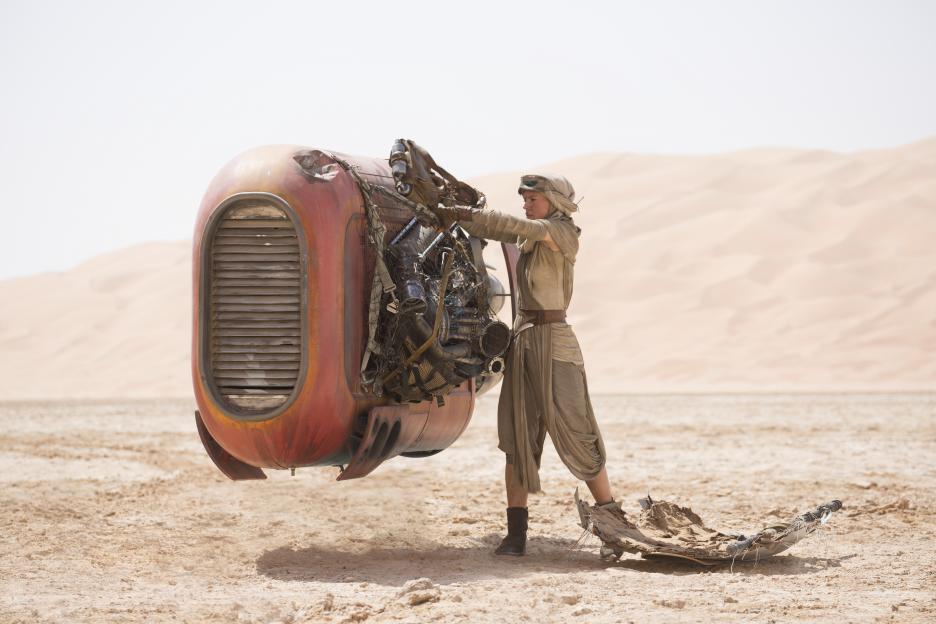
Rey on a scavenger mission.
11 more images in gallery
One of the most memorable scenes in the Star Wars film series is from Episode IV: A New Hope. Luke Skywalker, then just a farmer, looks out onto the horizon as two suns set on the planet of Tatooine. There is the feeling of hope, and a sense that an adventure is about to begin.
We know what happens from there. Luke begins a journey with Obi-Wan Kenobi, saves his sister, Leia, and becomes a Jedi Knight. He fights in the Battle of Endor and his father, Darth Vader, saves him from the Emperor. Return of the Jedi, the last film, chronologically, neatly ties up Luke’s story and all other subplots. Everyone is happy, dancing on Endor with Ewoks (no Ewoks in the new film, promise). It was a solid ending to the series, but where do you go from there after 32 years?
Read 8 remaining paragraphs | Comments

 Jodel ist eine App zur anonymisierten Kommunikation mit Menschen in der unmittelbaren Umgebung. Sie entwickelt sich an Universitäten zu einem Social-Media-Phänomen. Rund eine Million Nutzer jodeln regelmäßig. Wir waren bei dem Berliner Startup zu Besuch und haben mit dem Gründer gesprochen. (
 Huawei hat nach eigenen Angaben das WLAN für Hotels neu erfunden. Eine dreischichtige Architektur soll die Lösung bringen. Dabei kommen auch mehr Kabel zum Einsatz. (
 Aus Aluminium ist die Tastatur Brydge Pro gefertigt, an der das iPad Pro mit Scharnieren befestigt wird. Die Gerätekombination sieht aus wie ein Notebook und erlaubt im Gegensatz zu Apples eigener Tastatur die Anpassung des Anstellwinkels. (
 Für die Smartwatch Pebble Time gibt es ein Firmware-Update auf Version 3.8 sowie eine neue App-Version, mit der die Uhr einen Schrittzähler mit einfachem Trainingsprogramm erhält. (
 Apple hat eine Chipfabrik in San Jose übernommen, die künftig Prototypen fertigen könnte. In Taiwan gründete Apple ein Forschungszentrum für Displaytechnik. Künftig will Apple große Teile der Entwicklung selbst übernehmen - wie schon jetzt beim Chipdesign der SoCs. (